Every week we get the same email from a first-time buyer. It usually goes something like this: "I want to watch raccoons at the bird feeder. Will a $95 digital night vision monocular focus on them at 10 feet?"
The short answer is yes — but with caveats that most product pages won't tell you. We've been selling budget digital night vision devices since 2024, and close focus is the single most misunderstood spec on the listing. It's also the reason customers email us back confused after the first night.
What "close focus" actually means
Close focus distance is the nearest object a lens can render sharply. On a pair of 8x42 daytime binoculars it's often 6 to 10 feet. On a digital night vision monocular, it works differently because you're not looking through glass directly — you're looking at a small screen fed by a sensor.
That changes everything. The sensor's fixed focus, the IR illuminator's bloom at close range, and the LCD's resolution all conspire to make near-distance viewing the weakest part of any budget digital NV device.
What we measured
We grabbed three of our own units off the shelf last Tuesday and walked our backyard at dusk with a tape measure. Here's what we actually saw on a real October evening:
| Distance | What we could identify | |---|---| | 0.5 m (1.6 ft) | Blob. IR bloom washes out everything in front of the lens. | | 2 m (6.5 ft) | Shape of a squirrel, but whiskers are mush. | | 5 m (16 ft) | Clear enough to identify a raccoon's mask pattern. | | 20 m (65 ft) | Sharp on screen, but digital zoom degrades if you crop in. | | 100 m+ | Range spec territory — fine for large animals, forget birds. |
The 5-meter number is the one that matters for bird feeder watching. Most people picture their feeder 6 to 15 feet from the window, and that's exactly where budget digital NV starts to work.
The 0.5 m problem
Point the monocular at your own outstretched hand and turn on the IR. You'll see a bright white bloom that obscures everything within arm's reach. This isn't a defect — it's physics. The IR LED floods the near field, and the sensor can't handle that much reflected light.
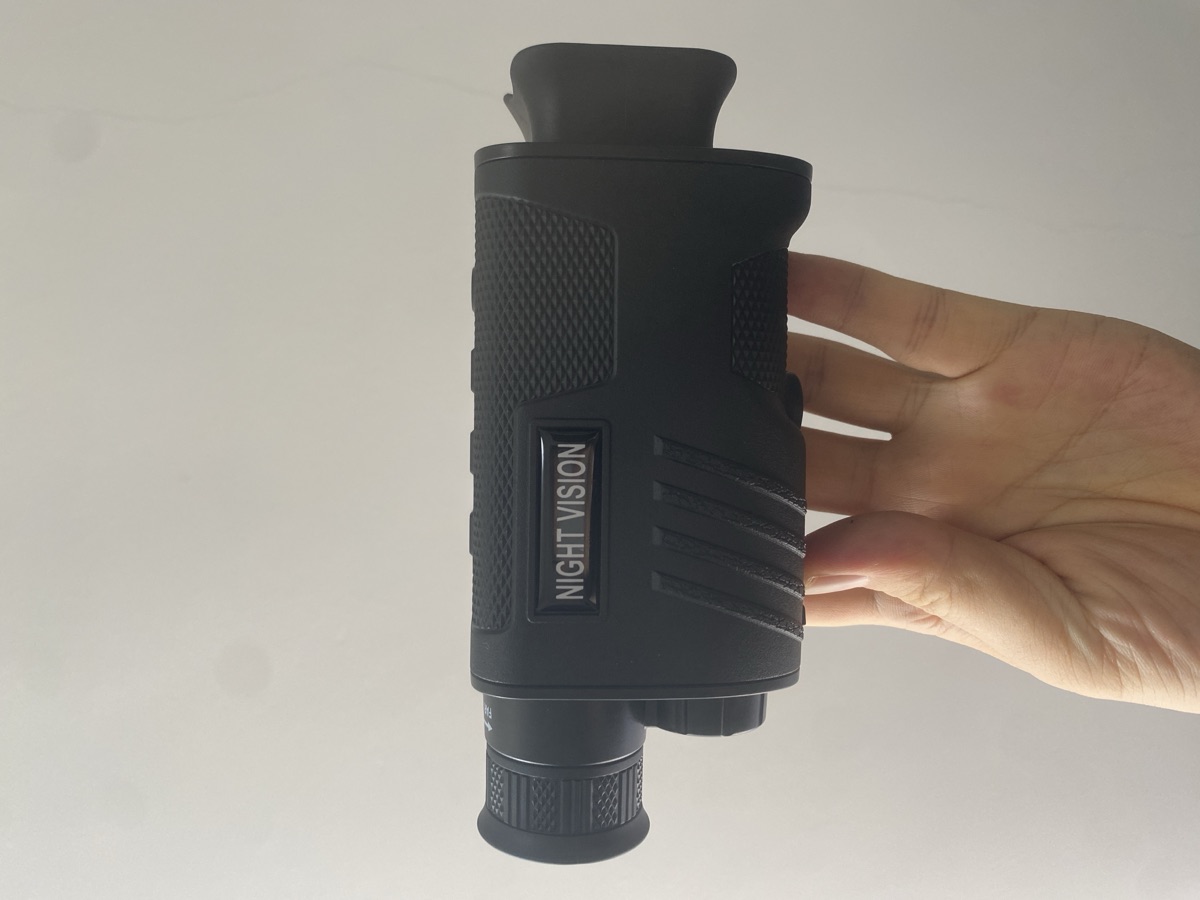
Some customers try to cover the IR LED with electrical tape to fix this. We don't recommend it. It kills night range completely and doesn't actually fix focus — it just darkens the bloom. If you want to see something at arm's length, turn the IR off and use the screen in starlight mode. On a quarter-moon night that works fine. On a moonless night, you're out of luck at that distance.
2 to 5 m is the sweet spot
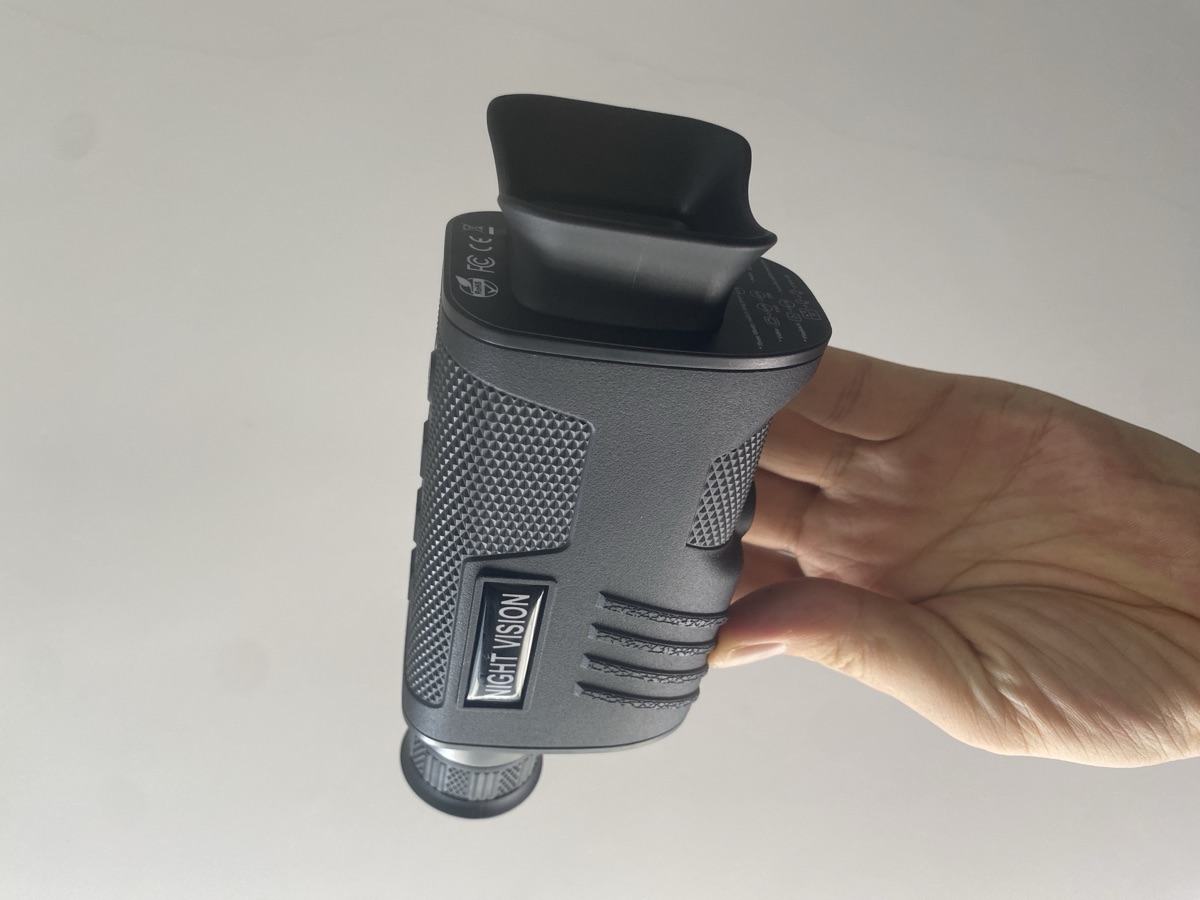
At 6.5 to 16 feet, our NV-LG64 handheld monocular does what people buy it for. You can sit by the kitchen window, watch the raccoons tip over the feeder, and make out the white ring around a skunk's tail. The screen image is green-tinted when IR is on, and you'll see some grain — but it's enough to identify species and behavior.
We get emails from customers who expected "Predator"-level clarity. That's not this device. What you get is a usable green-and-black view of a backyard you've never seen after dark. The first time you watch a possum wander across your fence line at midnight, you'll understand why people buy these.
Beyond 20 m
Past 65 feet, the close-focus advantage disappears and range becomes the limiter. The NV-DT19 monocular with its 2.5K video sensor holds up better than the older 1080p units at distance, but neither will resolve a bird on a branch 100 yards out. For that you'd need a binocular-style device with a larger objective lens, like our NV-DT29.
Tube NV vs digital: why close focus differs
If you've spent any time on r/NightVision, you've seen people gush about Gen 3 tube devices. Those are image-intensifier tubes, not digital sensors. A tube NV device has true optical focus and can focus down to a foot or less — which is why people use them for reading maps in the dark.
But tubes cost $2,000 and up. Our digital monoculars sit at $95. The trade-off is that you accept:
- IR bloom within 1.5 m
- Screen-based viewing (not direct optics)
- Grain that gets worse as you zoom digitally
- A 3-inch screen that limits your field of view
If that sounds like a dealbreaker, save up for a tube. If you want to watch raccoons from your patio, a digital unit does the job. We tell customers this directly because returns are expensive for both of us.
Cold weather and battery life
One thing nobody mentions on the spec sheet: close focus gets slightly worse in cold weather. When the temperature drops below freezing, the IR LED's output drifts and the bloom zone widens by about 30%. We noticed this testing in December last year — a monocular that focused fine at 5 m in October turned mushy at 3 m on a 28°F night.
The fix is simple. Keep the device in an inner jacket pocket when you're not using it, and let it warm up for five minutes before you start watching. Rechargeable batteries also lose about 20% of their runtime in cold, so bring spares if you're camping in winter.
What we tell customers who email us
We tell them three things before they order:
- Measure your actual viewing distance. If the feeder is 10 feet from the window, any of our $95 monoculars works. If it's 30 feet, you'll want the 300 m-rated NV-LG64 over a shorter-range unit.
- Turn off IR in partial moonlight. At quarter moon, the starlight sensor on our newer units (like the NV-NV2180 binocular) gives a color image without IR bloom. Close focus improves dramatically because there's no flood.
- Don't expect rifle-scope clarity. This is consumer gear. It sees in the dark. It doesn't see like daytime binoculars.
A note on the spec sheet
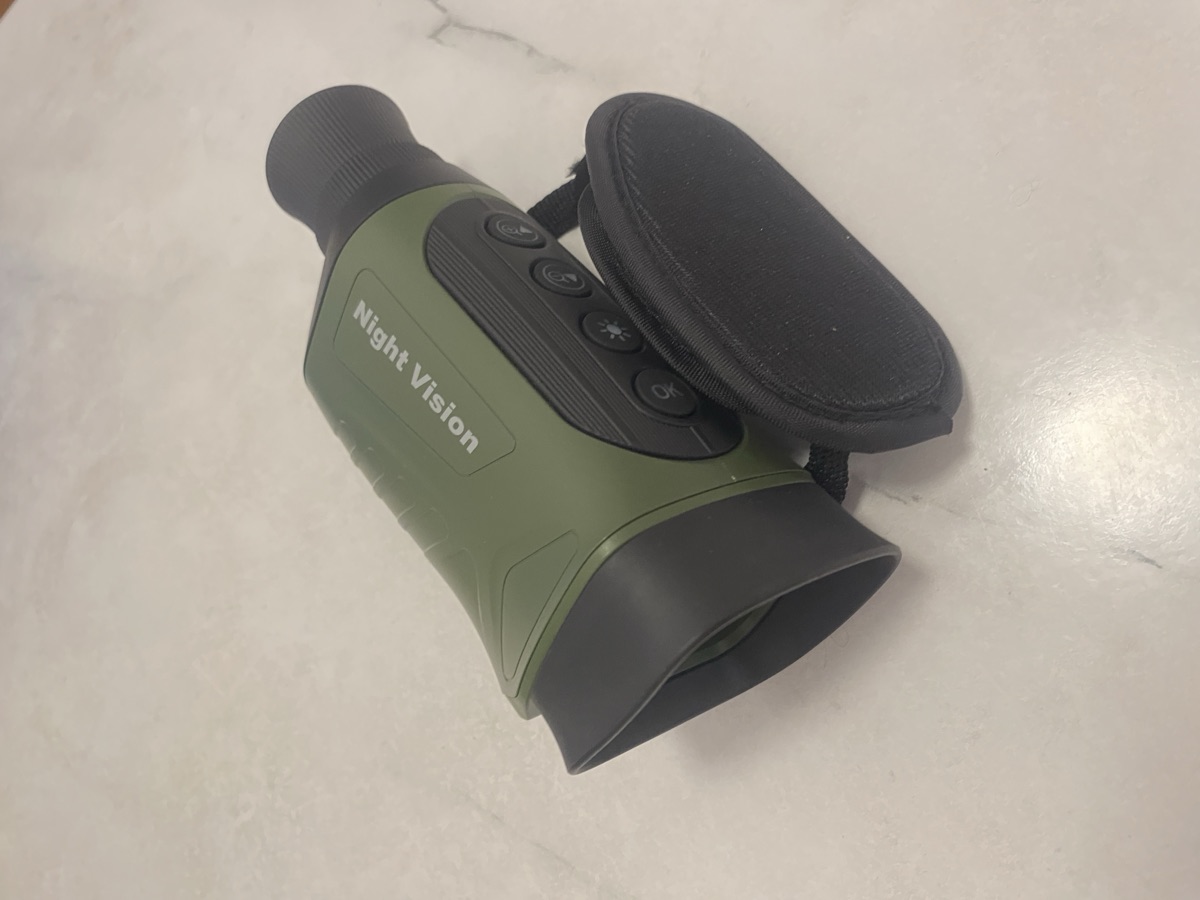
You'll see "300 m range" advertised on the box. That's the maximum detection range at night for a human-sized shape against a clean background. It is not the close-focus number. Close focus is rarely advertised because it's not flattering — the honest answer for most budget digital monoculars is 2 to 3 meters.
We list the range spec because it's what people search for, but we'd rather write this article than have you return a unit because the feeder was too close.
FAQ
Q: Can a digital night vision monocular focus on a bird feeder 10 feet away?
A: Yes. At 3 meters it's the sweet spot for budget digital NV. You'll identify species and behavior, though fine details like feather texture will be soft.
Q: Why does everything look blurry when I point the monocular at my hand?
A: That's IR bloom, not a focus error. The infrared LED floods objects within 1.5 meters. Pull back to at least 6 feet and the image clears up.
Q: Should I buy a monocular or binocular for close backyard viewing?
A: For a feeder 10 to 20 feet away, a monocular is fine and cheaper. If you're watching 30+ feet or want stereo depth, step up to a binocular like the NV-DT29.
Q: Does close focus improve with more expensive digital NV?
A: Slightly. Higher-sensor units with starlight mode (IR off) focus closer because there's no bloom. But the fundamental limit is the fixed-focus sensor — true near-focus requires tube tech, which starts around $2,000.
Q: Can I use a digital night vision monocular during the day?
A: Yes, but only with the IR off. Pointing it at bright daylight with IR on can damage the sensor over time. The color camera mode works fine on overcast days, though it won't outperform your phone.