When a customer emails us asking which digital night vision to buy for wildlife watching, the first question we ask back is never "how much do you want to spend." It's "one eye or two?" The answer changes the whole purchase, and we've watched enough people pick wrong to know that "night vision monocular vs binocular for wildlife watching" isn't a trivial split. We sell both at Voitrek, and in this post we'll tell you which one we actually hand to our own field testers on a deer stand, a marsh boardwalk, and a backyard camera trap setup.
The Real Difference: It's Not About Magnification
A lot of buyers assume a binocular is just "a monocular with a second tube bolted on." That's not how digital night vision works. A digital monocular has one sensor, one screen, and one eyepiece. You hold it like a compact camera and look through one eye. A digital binocular has either two feeds on a single screen (cheap builds) or two sensors feeding two eyepieces (our 4K helmet units). The experience is night and day — literally.
What changes in the field:
- Depth perception. With a monocular, your brain gets a flat picture. You can tell a raccoon from a stump at 40 yards, but judging distance to a bird in the reeds takes practice.
- Eye fatigue. One eye open, one eye closed or covered. On a two-hour sit, that "closed" eye gets bored and starts to wander. We've had testers come back with headaches.
- Weight. A monocular is 9–12 oz. A binocular is 1.5–2.5 lb. That matters when you're carrying it four miles into a wetland.
- Sharing. A binocular is awkward to hand to a friend — they have to fit their eyes to your interpupillary distance. A monocular you just swap.
When We Recommend a Monocular
1. You're hiking to the spot, not driving to it
Our field tester in coastal North Carolina does a 1.8-mile boardwalk loop at dusk to watch a heron rookery. He carries the Voitrek handheld digital night vision monocular clipped to a chest strap. He says the binocular he tried on the same trail hung heavy enough that he found himself leaving it in the truck by week three.
A monocular wins when the journey itself is part of the trip. It also tucks into a jacket pocket, a kayak console, or a daypack side pocket without a case.
2. You already carry one camera and don't want two
A lot of wildlife watchers pair a monocular with a spotting scope or a regular daytime binocular. The monocular does the "first light, last light, under dense canopy" work; the daylight optics handle the bright hours. That's a gear-light setup we recommend over buying a single heavier night vision binocular that compromises on both ends.
3. You're solo and want to record video one-handed
Every digital NV unit we sell records to microSD. A monocular is one-handed friendly: thumb on record, index on IR focus. We've recorded fox kits playing at 2 a.m. while holding the unit in one hand and a thermos in the other. Try that with a 2-lb binocular and you'll be leaning on a tree.
When We Recommend a Binocular
1. You're sitting still for 90 minutes or more
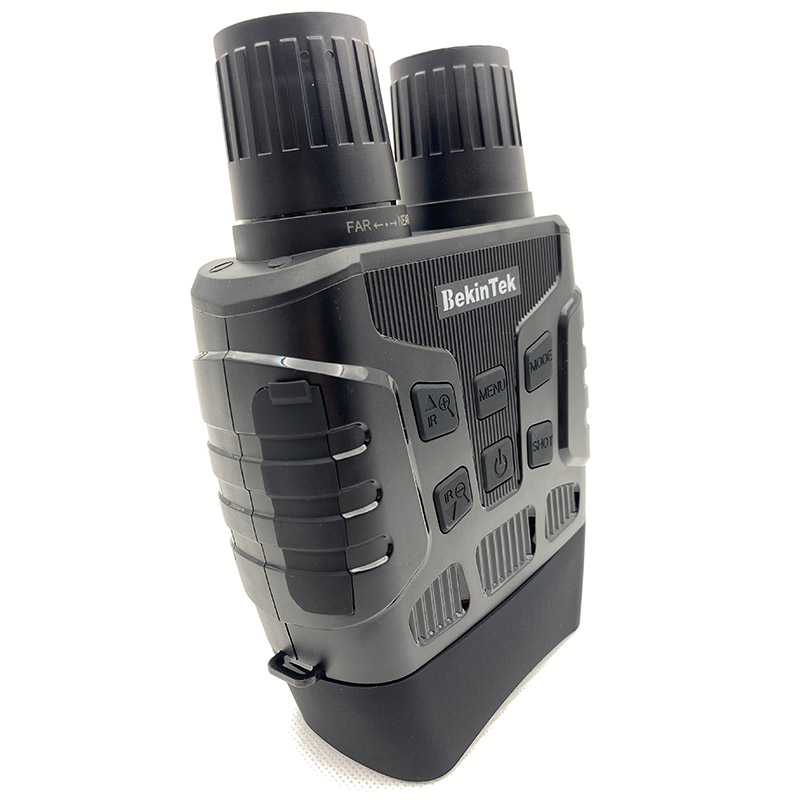
This is the big one. The Voitrek handheld 4K night vision binocular is what our testers use on a fixed sit — a deer stand, a marsh blind, a backyard owl box. Two eyes open means your brain processes the scene naturally. You notice the deer's ears flick before you actually hear it. You track a skunk moving through three distinct frames of undergrowth without the picture feeling flat.
On a stationary sit, the 2 lb weight cost disappears. You're resting the unit on a rail, your knees, or a tripod.
2. You need true stereo depth to judge distance
If you're trying to decide whether the shape in the brush is a fox at 60 yards or a feral cat at 25, binocular stereo matters. We had a customer in Michigan who returned a monocular after missing a bobcat ID three nights in a row — with the binocular, he told us he could immediately tell the bobcat was farther than it looked because the fence posts lined up in depth.
3. You want to mount it on a helmet or head mount
Hands-free wildlife watching — tracking a raccoon on a roof, watching bats over a pond — requires a binocular form factor. The Voitrek 4K helmet-mountable binocular has a balanced center of gravity that doesn't torque your neck. A monocular on a strap swings. We don't recommend head-mounting monoculars for longer than 20 minutes.
Honest Limitations We Don't Put on the Box
Here's what our support inbox actually hears, and what we tell customers before they buy:
- **Digital NV is not film-grade black. ** Off-IR, you get color; on IR, you get green or monochrome white-hot. It's sharp on a 2.3" screen, not sharp enough to crop a photo of a wing feather. Set expectations.
- IR range is 150–250 yards on a clear night, not 1,000. Anything marketed at "1,000 ft night vision" is inflating the number. We test our units on a measured range and report the number at which we can identify eyeshine, not "see a blurry blob."
- Battery life drops in cold. Below 40°F (4°C), expect 60–70% of the rated runtime. Bring a power bank.
- Neither monocular nor binocular beats moonlight alone. If there's a half-moon and you're in open terrain, a $20 pair of 10x42 daytime binoculars will outperform any digital NV. Save the NV for overcast nights, dense cover, and pitch-black backyards.
Quick Decision Cheat Sheet
| Your situation | We recommend | |---|---| | Hiking to a wildlife spot, solo, under 30 min sits | Monocular | | Fixed sit (blind, stand, backyard), 1+ hours | Binocular | | Recording video one-handed, hands-free not needed | Monocular | | Helmet-mounted, hours of hands-free use | Binocular | | Backpack/weight-sensitive multi-day trip | Monocular | | Need stereo depth to ID animals at distance | Binocular | | Budget under ~$150 | Monocular (you get more sensor for the money) | | Want the most immersive "real night" view | Binocular |
FAQ
Is a night vision monocular as good as a binocular?
For short sessions, yes. For long sits and depth judgment, no. We tell customers to budget based on what they'll actually do, not on the form factor they think is "cooler."
Can I use one eye on a binocular?
Yes, but then you're carrying the weight of a binocular for the experience of a monocular. Not worth it.
Which is better for bird watching at night?
Night birds (owls, nightjars) move fast and in trees. We lean binocular for depth, but the monocular wins if you're hiking between roosts.
Do monoculars have worse image quality than binoculars?
On our budget units, no — the sensor and screen are identical. The difference is stereo and eye comfort, not resolution.
Can I use night vision to watch my backyard at night?
Absolutely. Both work for raccoons, possums, deer, and neighbors' cats. If you just want to know what's digging up your lawn, a monocular is enough.
Bottom line: if you're mobile, solo, and weight-sensitive, go monocular. If you're sitting still for an hour or more, or you want to mount the unit, go binocular. We'll happily email you the real field notes — just reach out through the contact page and tell us your typical wildlife setup.